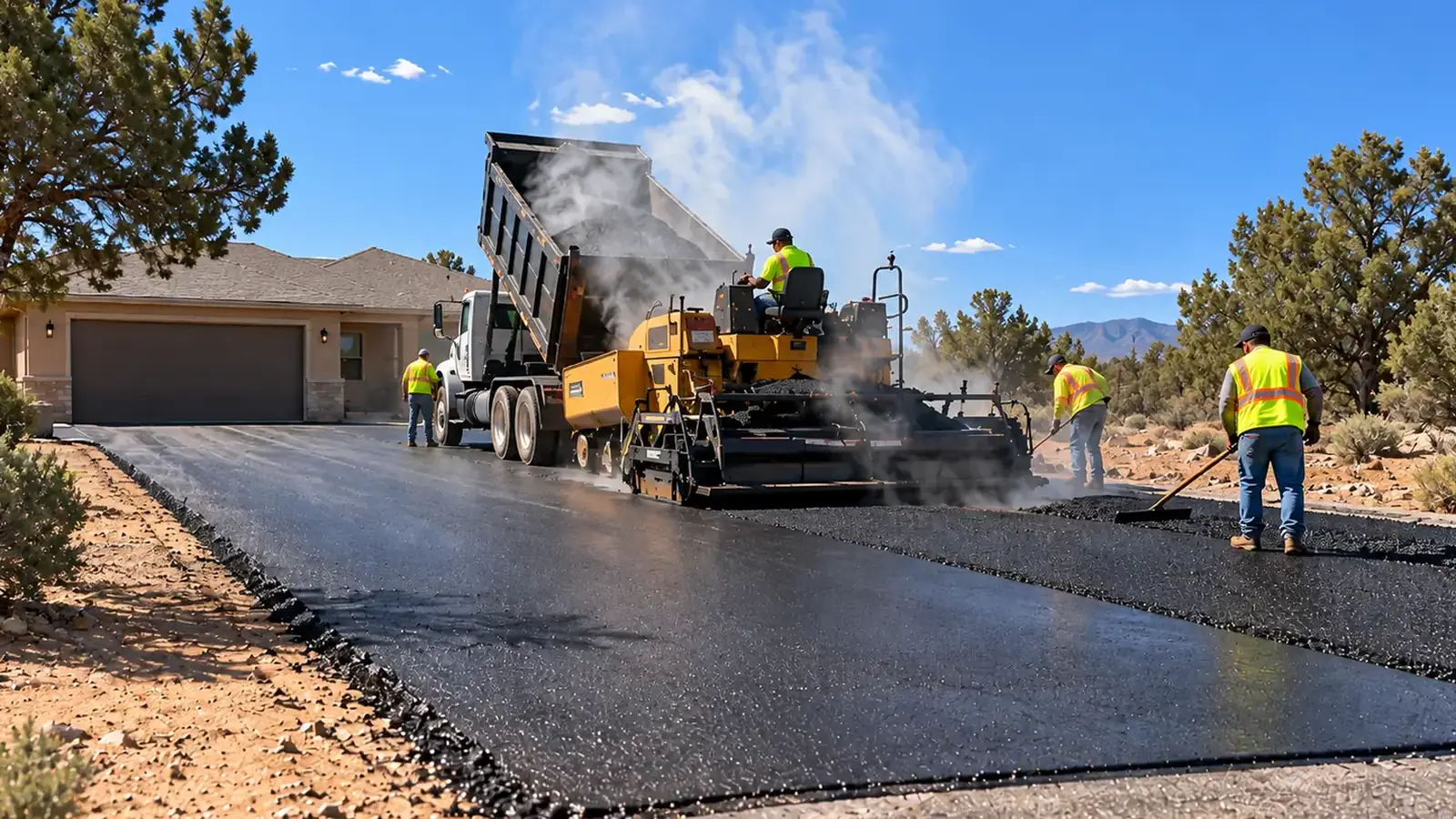
The valley soil problem
A lot of Bernalillo sits on the Rio Grande's valley floor, where the ground is flatter and the soil holds more silt and clay than the sandy mesa above. That soil stays wet longer, softens under load, and can shift as it dries. A driveway built flat on top of it tends to hold puddles, rut and crack.
How we build Bernalillo driveways
- Check the ground. At the quote we look at soil, existing base and how water moves on your lot.
- Remove what won't hold. Topsoil and soft, wet material in the driveway footprint come out.
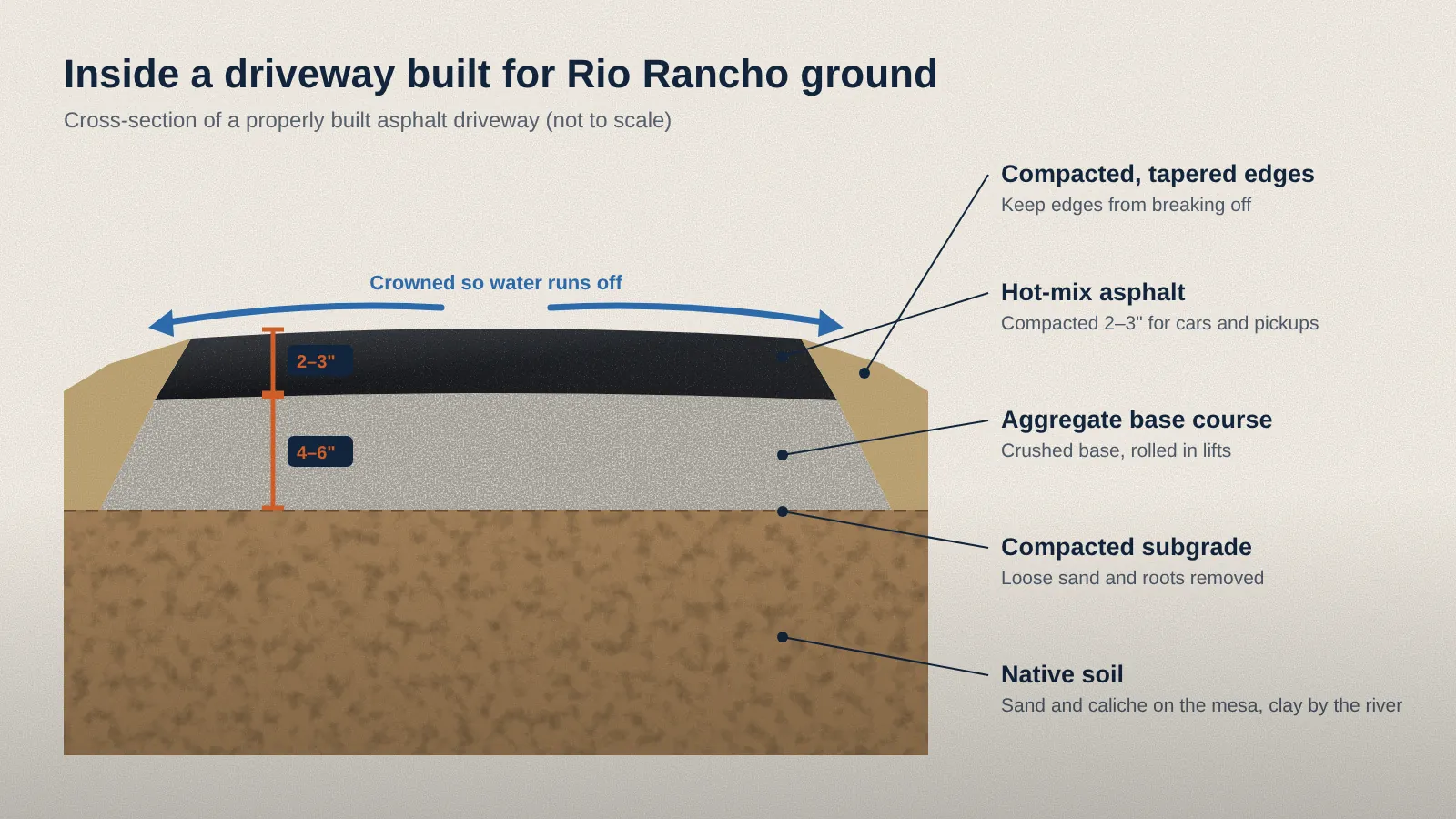
- Build in slope. A crown or cross-slope so water always leaves the surface, with an outlet to send it somewhere safe.
- Thicker compacted base where the soil is soft or heavy vehicles park.
- Pave and finish. Hot-mix compacted to the right thickness, with tapered edges and smooth transitions.
Gravel conversions
If you have a gravel drive, good clean gravel can become part of the new base. We regrade it, add base where it's thin, compact and pave. How conversions work.
Longer drives
For long rural drives, consider asphalt near the house with chip seal or millings beyond. Price ranges are in our cost guide.
Common questions
Why does my driveway hold water?
Usually because the base wasn't sloped to drain on flat valley ground. The fix is regrading and rebuilding the base, not just patching.
How thick should a Bernalillo driveway be?
Commonly 2–3 inches of compacted asphalt over at least 4–6 inches of compacted base — more over soft soil or where heavy vehicles park.
Do you serve Algodones and Placitas too?
Yes, along with the rest of the Bernalillo area.
Related pages
Bernalillo
River-valley homes, farms and businesses in the Town of Bernalillo.
Read more →Dirt & Gravel to Asphalt
Turn dust, ruts and loose gravel into a clean asphalt drive.
Read more →Grading, Drainage & Base
Excavation, grading, culverts and compacted base — the part that makes paving last.
Read more →