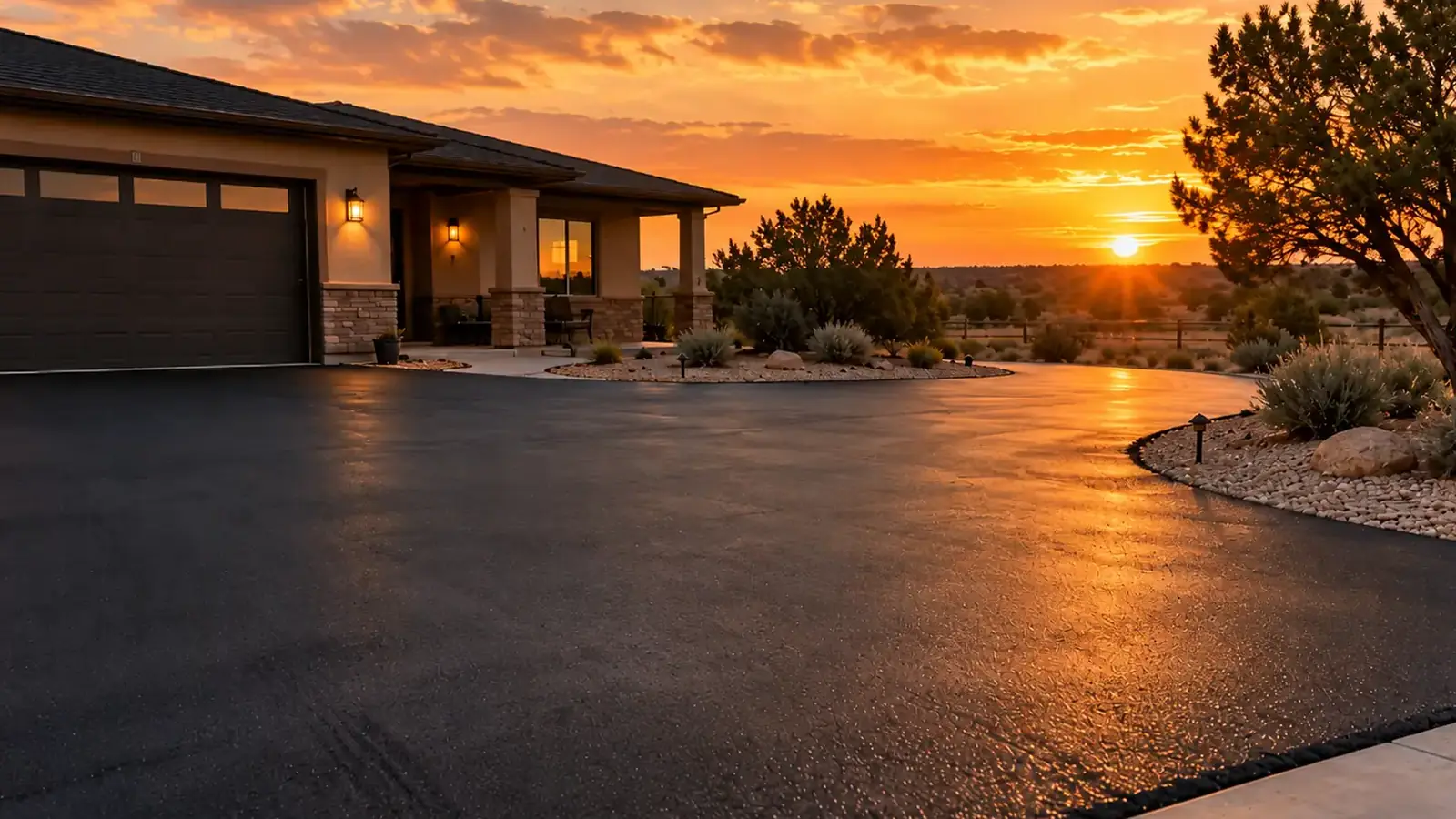
A common project in Rio Rancho subdivisions
A lot of homes in Rio Rancho and on Albuquerque's West Side already have a concrete driveway out front — and a strip of gravel or dirt along the side of the house where the RV, boat or trailer lives. That strip ruts, sinks under the tires and turns into a sandbox in the wind. Asphalt is one of the most economical ways to turn it into a solid, clean parking area.
Built for the weight
An RV pad isn't a driveway. A loaded motorhome or fifth-wheel puts far more weight on each tire, and it sits in the same spot for weeks. That's why we build RV pads heavier:
- Deeper base. More compacted aggregate under the tires than a car-only driveway.
- Thicker asphalt. A heavier section where the wheels and leveling jacks sit.
- Pads under jacks. We'll recommend jack pads or boards so stabilizer feet don't sink into the asphalt on hot days.
- Clean tie-in. A smooth transition from your concrete driveway or curb so you're not dragging a hitch over a lip.
Typical layouts
Side-yard pad
From the driveway, through the side gate, along the house. We check gate width, swing and turning room before we start.
Driveway widening
An extra lane beside the existing driveway for a second truck or trailer.
Rear access
On larger lots, a lane to a back-yard pad, shop or garage.
Parking apron
A wider turnaround so you can back a trailer in without driving on the yard.
Check your HOA first
Many neighborhoods have rules about RV parking, side-yard surfaces and what can be seen from the street. If you're in an HOA, check the rules (or have us look at them with you) before the work starts. We're happy to provide a written scope and drawing for an architectural review submission.
Common questions
How thick should an RV pad be?
Thicker than a car driveway. We typically increase both the compacted base and the asphalt for RV pads; the exact section depends on the RV's weight and your soil.
Will RV leveling jacks sink into asphalt?
On hot days, small jack feet can press into any asphalt. Use jack pads or boards to spread the load — we'll recommend sizes.
Can you pave through my side gate?
Usually. We check the gate width and turning room during the quote; sometimes a gate post or fence section needs to move.
Do I need HOA approval?
If you're in an HOA, very possibly. We can give you a written scope and simple drawing for the submission.