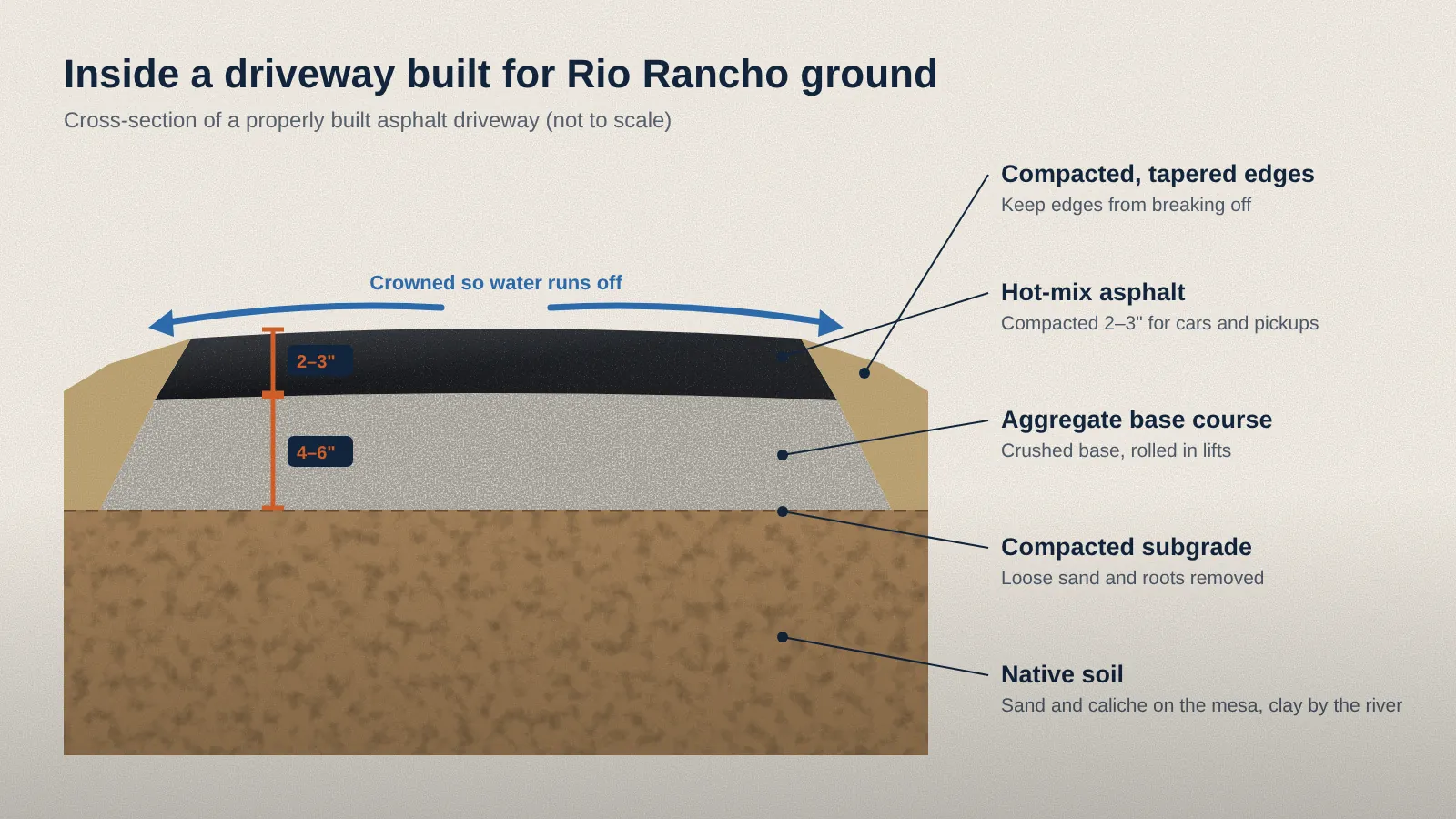
What's under a Rio Rancho lot
Most of Rio Rancho sits on the mesa west of the Rio Grande, on deep deposits of sand and gravel. In many places the top layer is loose, wind-blown sand. Some lots have a hard, cemented layer called caliche within a few feet of the surface. Down in the valley — Bernalillo, Corrales near the river, Los Ranchos — the soil shifts toward silt and clay. Each behaves differently under a driveway.
Loose sand
Drains well but has little strength when loose, shifts under wheel loads and erodes fast once water starts moving across it.
Caliche
Very hard and dense. Great support, but water doesn't soak through it, so it can trap moisture right under your base.
Construction backfill
The ground right beside newer houses is often loose fill that keeps settling for years.
Valley silt and clay
Holds water, softens when wet and can move as it dries.
How driveways fail on sand
- Edges break off. The sand beside the pavement was never compacted or supported, so the edge has nothing to lean on.
- Shoulders wash out. Monsoon runoff runs along the edge and carries the sand away.
- Dips and ruts. Loose sand under the base keeps compacting under traffic.
- Cracks from below. Water trapped on caliche or in a soft spot weakens the base, then freezes and lifts the surface.
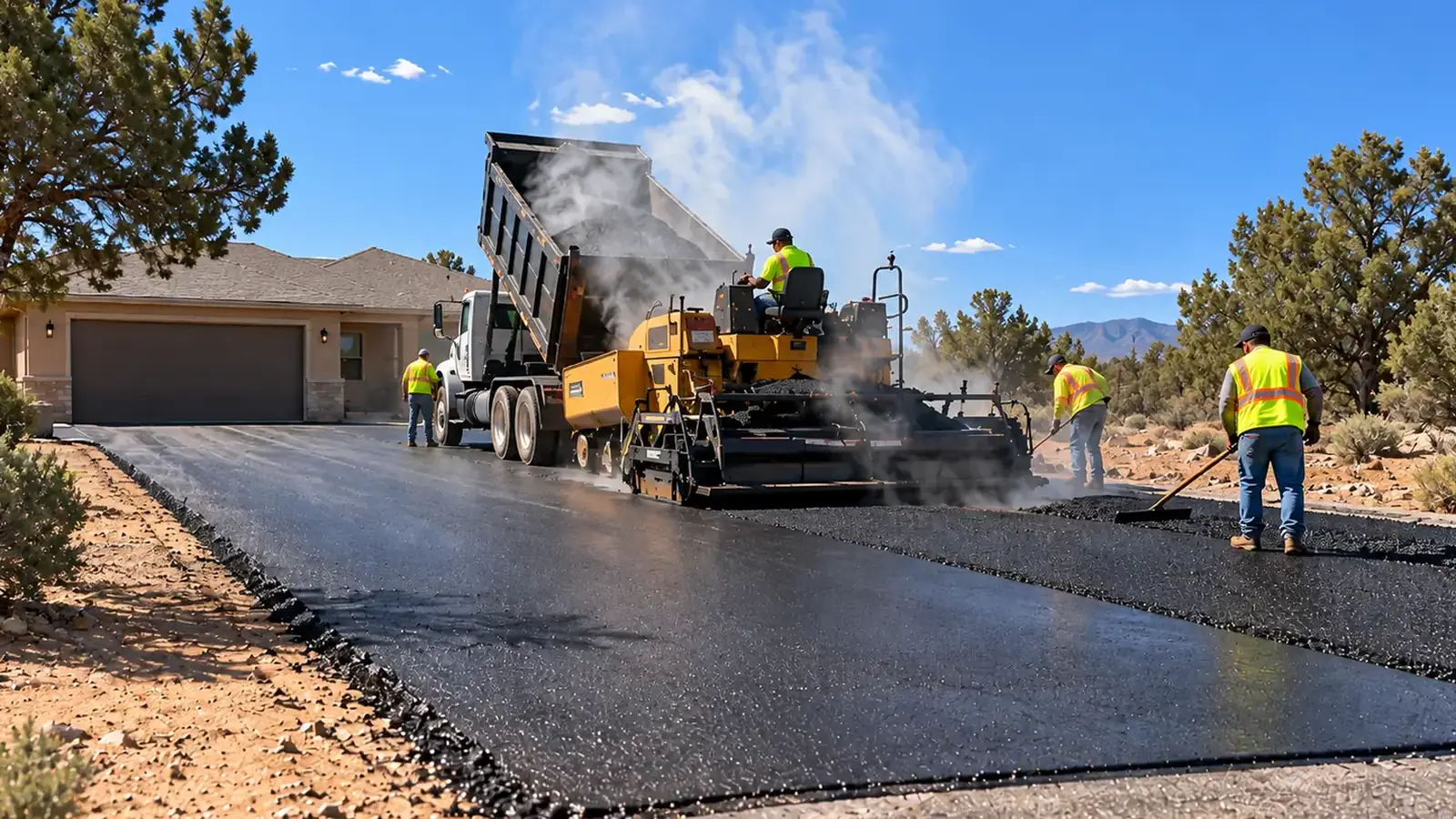
What a proper build looks like
- Strip loose surface sand, roots and debris; dig out backfill and soft spots.
- Where caliche sits high, break out high spots or set grades so water doesn't pond on top of it.
- Shape the subgrade to drain, then compact it.
- Place 4–6 inches (or more) of crushed aggregate base in lifts, water and roll each one.
- Pave to the right thickness and finish edges with a compacted taper and backfilled shoulder.
- Give runoff a planned path off the property.
Questions to ask any contractor
- How deep will you excavate, and what happens if you hit soft sand or caliche?
- What base material, how thick, and how will it be compacted?
- What will the finished asphalt thickness be after rolling?
- How are you handling the edges and the water?
Common questions
Is sand bad for driveways?
Not if it's handled right. Sand drains well, but it needs to be confined and compacted under a real base, with edges supported and runoff controlled.
What is caliche?
A natural, cemented layer of calcium carbonate common in New Mexico soils. It's very hard and doesn't drain, so it affects how water moves under a driveway.
Why is the area by my house always settling?
It's usually construction backfill that was never fully compacted. Under new pavement, it should be dug out and replaced with compacted base.
Related pages
Grading, Drainage & Base
Excavation, grading, culverts and compacted base — the part that makes paving last.
Read more →New Asphalt Driveways
Hot-mix driveways built on a compacted base made for sandy mesa soil.
Read more →Driveways on Dirt-Road Lots
Asphalt, chip seal, millings or gravel on a lot with a dirt road.
Read more →